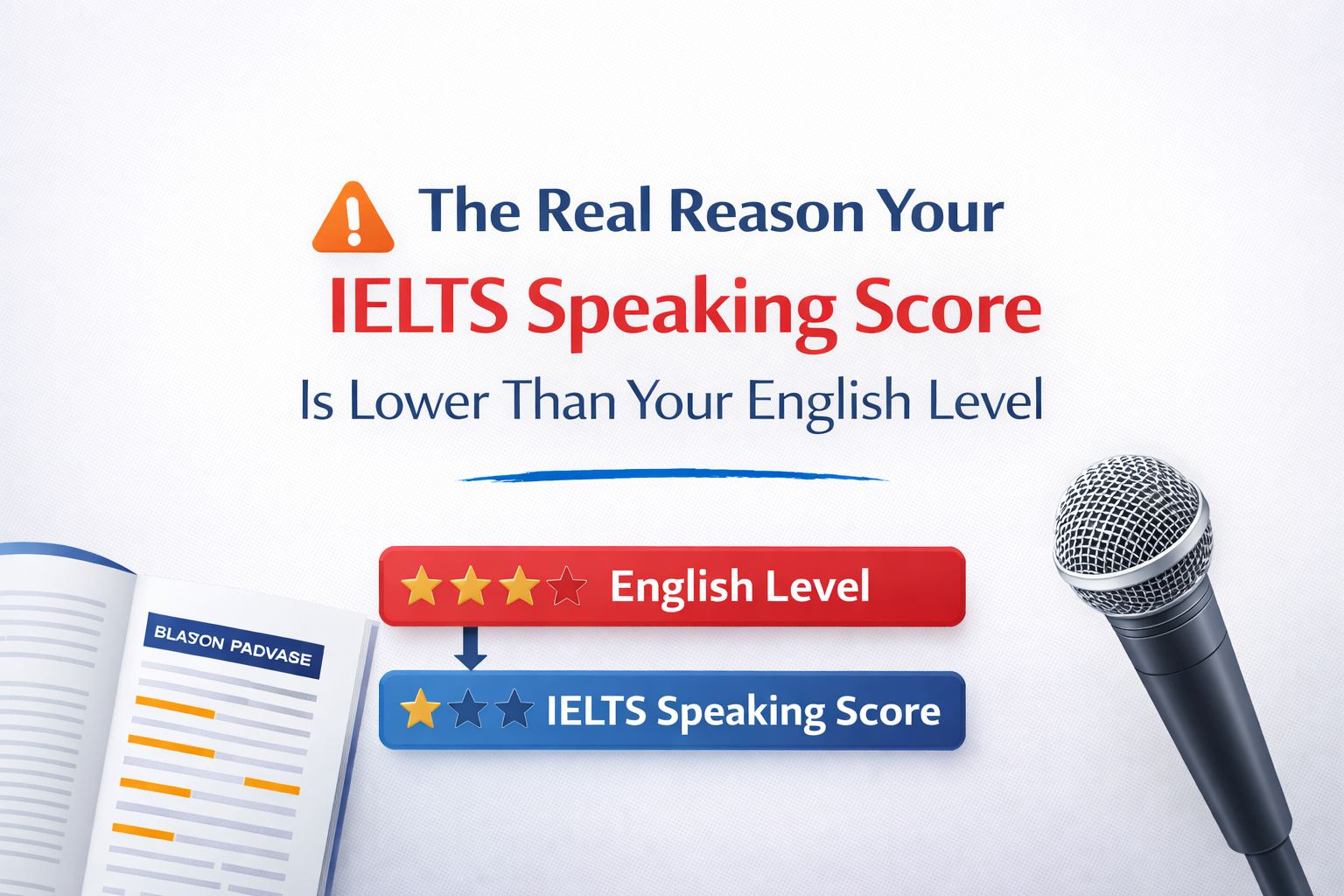
You speak English every day. You watch English films, read English articles, and communicate confidently in English at work or university.
Then you walk into the IELTS Speaking test and score Band 6.
If this sounds familiar, you are experiencing one of the most frustrating experiences in IELTS preparation — and it has a very specific cause.
The Exam Is Testing Something Specific
IELTS Speaking does not test how much English you know. It tests four specific skills simultaneously under pressure:
Fluency and Coherence — Can you speak continuously without long pauses? Are your ideas organised logically?
Lexical Resource — Do you use a range of vocabulary naturally and precisely — not just correctly?
Grammatical Range — Do you use varied sentence structures, or do you default to simple sentences when nervous?
Pronunciation — Are you easy to understand? Do you use appropriate stress and intonation?
You can be a confident English speaker in daily life and underperform on all four of these criteria under exam conditions. Here is why.
The Three Exam-Specific Problems
Problem 1: Silence That Feels Like Seconds But Sounds Like Minutes
In normal conversation, a two-second pause feels natural. In an exam setting with a silent examiner watching, two seconds feels like ten — and it costs you Fluency marks.
This is not a language problem. It is a psychological one. You know what you want to say but the pressure creates a mental block.
Fix: Replace silence with natural hesitation language. These phrases give your brain thinking time without the awkward silence:
- "That is an interesting question — I would have to say..."
- "Let me think about that for a moment..."
- "Honestly, I have never really considered that before, but..."
These sound natural. Silence does not.
Problem 2: Your Vocabulary Shrinks Under Pressure
In relaxed conversation you use sophisticated vocabulary without thinking. Under exam pressure, your brain defaults to safe, simple words — and your Lexical Resource score drops.
Fix: Prepare topic vocabulary in advance for the most common IELTS Speaking topics — technology, environment, education, health, society. Not memorised sentences — just key phrases and collocations you can reach for naturally.
Problem 3: You Are Monitoring Yourself Instead of Talking
Many candidates spend the Speaking test half-talking, half-listening to themselves — checking every sentence for errors before speaking it. This kills fluency immediately.
Fix: Prioritise communication over perfection. Examiners expect occasional errors — they are not counting mistakes, they are assessing overall impression. A confident, flowing answer with two minor errors scores higher than a hesitant, perfect one.
What the Examiner Wants to See
Examiners are trained to give marks, not take them. They are looking for evidence of ability — not trying to catch errors.
The candidates who score highest are not the ones with the most impressive vocabulary. They are the ones who seem most comfortable — who speak at a natural pace, develop their ideas confidently, and engage with the questions as if having a conversation rather than taking a test.
That feeling of comfort comes from one source: practice under realistic conditions.
The Practice Method That Works
Record yourself answering Speaking questions. Listen back without reading along. Ask: Did I hesitate excessively? Did I repeat the same words? Was my answer developed enough?
Do this daily for four weeks. The improvement in fluency and confidence is consistently significant — not because your English improved, but because speaking under pressure stopped feeling unusual.
🎤 Practice your Writing while you prepare your Speaking Writing is worth the same marks as Speaking. IELTS Evaluator gives you instant AI feedback on your essays — band score, detailed analysis, and a Band 9 model answer. Free to start.