The examiner hands you a card. You have one minute to prepare. Then you must speak for up to two minutes without stopping.
For most candidates, Part 2 is the most stressful moment in the entire IELTS exam. Not because they cannot speak English — but because speaking continuously for two minutes on a specific topic feels unnatural and overwhelming.
It does not have to be. Here is the system that makes it manageable.
What the Card Actually Gives You
Every Part 2 card follows the same structure. It gives you a topic — usually something to describe — and three or four bullet points telling you what to cover. The final bullet point almost always asks how you felt or why something was important to you.
The card is not a trap. It is a roadmap. Every bullet point is a paragraph. Your job is to walk through that roadmap for two minutes.
How to Use the One-Minute Preparation Time
One minute feels short. Used correctly, it is enough.
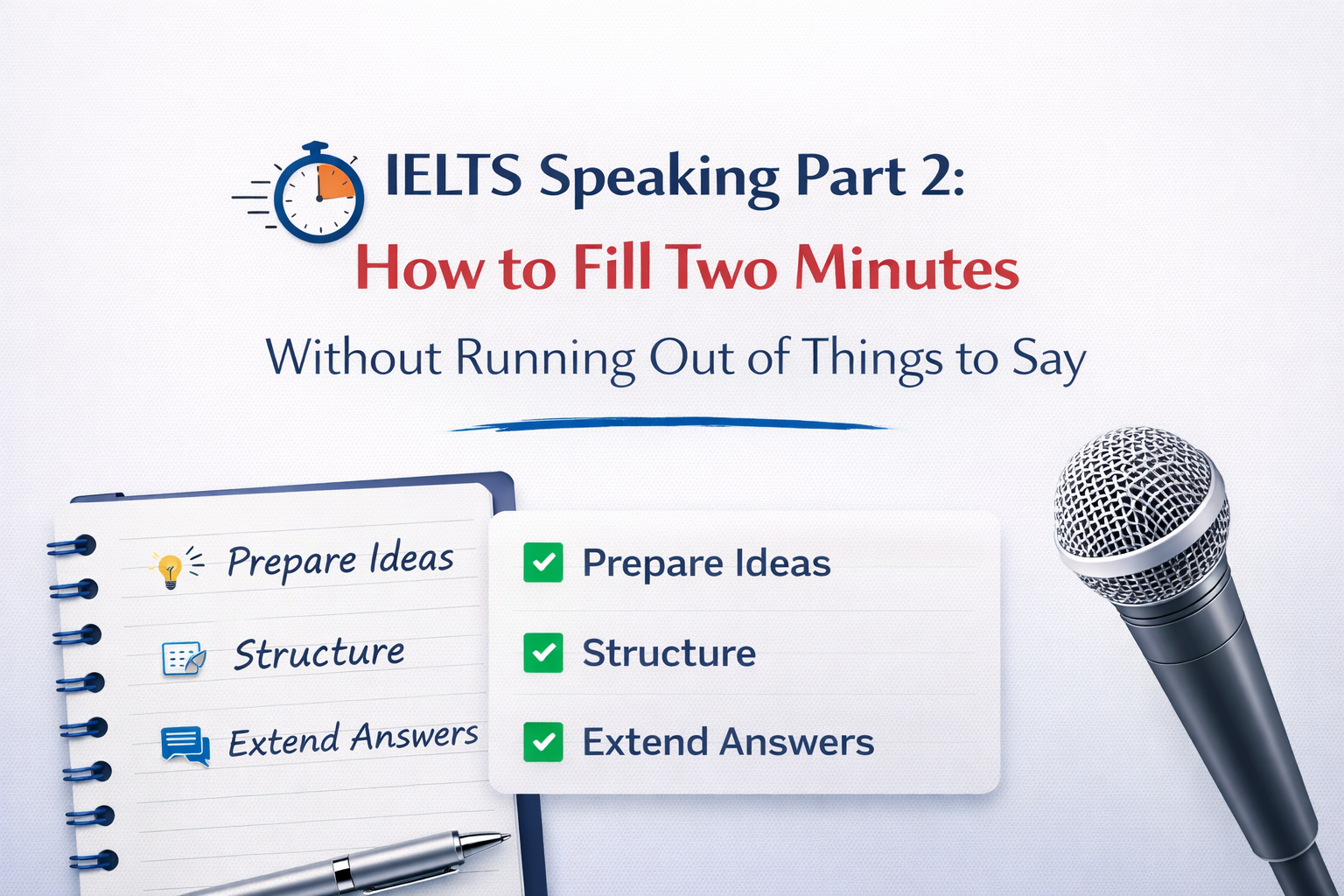
Do not write sentences. Write single words — one or two for each bullet point. These are memory triggers, not a script.
Add one specific detail for each point. The single biggest difference between a Band 6 and Band 7 Part 2 answer is specificity. General answers run out of content. Specific answers generate their own momentum.
Bad note: "holiday — beach — nice"
Good note: "Turkey 2023 — Antalya — old city, boat trip, sunset — felt completely disconnected from stress"
The good note gives you 30 seconds of content per bullet point. The bad note gives you one sentence.
The Structure That Fills Two Minutes Naturally
Opening (10 seconds): Introduce the topic directly and confidently. "I would like to talk about a holiday I took to Turkey in the summer of 2023."
Bullet 1 — Where/What (25 seconds): Give specific details. Name places. Use describing words. "We stayed in Antalya — a beautiful coastal city in the south of Turkey. The old city there is genuinely stunning — narrow stone streets, ancient walls, tiny restaurants hidden in the alleys."
Bullet 2 — When/Who (20 seconds): Context and company. "I went with my closest friend in August. We had been planning it for almost a year and had very high expectations — which, unusually, the trip actually exceeded."
Bullet 3 — Main activity or event (30 seconds): The heart of your answer. Give a specific memory. "The highlight was a boat trip we took on the second day. We spent six hours on the Mediterranean — swimming in water so clear you could see the bottom from ten metres up. I had never seen anything like it."
Final bullet — How you felt/Why memorable (25 seconds): This is your chance to show emotional and evaluative language. "What made it so special was how completely I switched off. I spend most of my life looking at a screen — on that boat there was no signal, no notifications, nothing. Just water, sun, and conversation. It reminded me what it actually feels like to rest."
Closing (10 seconds): Wrap up simply. "Overall it was one of the best trips I have ever taken and somewhere I would genuinely love to return to."
That structure, with those specific details, fills two minutes comfortably.
What to Do When You Run Out of Content
It happens. You reach the end of your bullet points with 40 seconds still on the clock. Here is how to extend naturally:
Compare it: "It was quite different from other places I have visited — most coastal destinations feel very commercialised, but this felt authentic."
Recommend it: "I would genuinely recommend it to anyone who enjoys history combined with beautiful scenery — it is the combination that makes it rare."
Reflect on it: "Looking back, I think what I valued most was not the destination itself but the complete change of pace. Those kinds of trips have become harder to justify as life gets busier."
Any one of these adds 20-30 seconds naturally without sounding forced.
The Rule That Changes Everything
Never stop before the examiner signals time.
Even if you have covered all your bullet points and feel finished, keep talking. Add a comparison, a reflection, a recommendation. The examiner cannot give you marks for content you did not produce.
🎤 Strengthen your Writing while you build your Speaking IELTS Evaluator gives you instant band scores and examiner-style feedback on any IELTS essay. Writing and Speaking are worth equal marks — practice both.