Most IELTS preparation advice focuses on weeks and months before the exam. Almost none of it addresses the 18 hours that matter most — the evening before and the morning of.
What you do in those final hours can meaningfully affect your performance. What most candidates do in those hours actively hurts it.
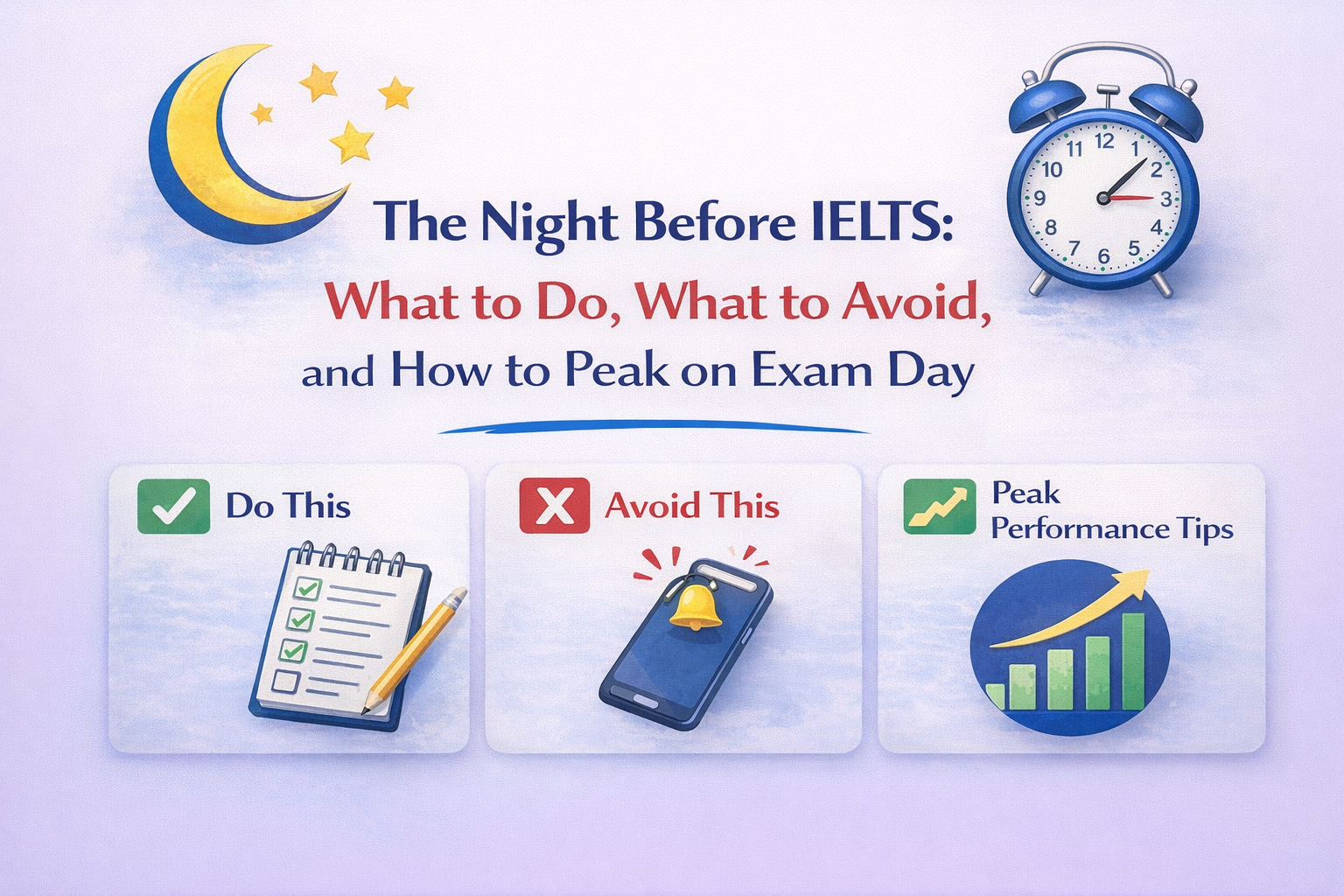
What Not to Do the Night Before
Do Not Study New Material
The night before your exam is not the time to learn new vocabulary, practise a new essay structure, or watch IELTS tutorial videos. New information learned under stress is poorly retained and creates anxiety about everything you do not know.
Your preparation is complete. Trust it.
Do Not Do a Full Practice Test
Some candidates do a full four-hour practice test the evening before the real exam to "stay sharp." This is one of the worst things you can do. You will arrive at the exam mentally fatigued, second-guessing every answer from the practice test, and with genuinely depleted cognitive resources.
Do Not Talk to Other Candidates
If you know others taking the exam the same day, avoid discussing it the evening before. Conversations like "I heard the Writing topics are really difficult lately" or "apparently the Reading passages are getting harder" serve no purpose except to increase anxiety about things you cannot control.
Do Not Stay Up Late
Sleep is not optional preparation. It is preparation. Memory consolidation, processing speed, and emotional regulation — all of which you need tomorrow — are directly impaired by insufficient sleep.
If you normally sleep at 11pm, sleep at 11pm. Do not try to sleep at 9pm because you think more sleep is better — lying awake for two hours is worse than your normal schedule.
What to Do the Night Before
Light Review Only
Spend 20-30 minutes maximum reviewing things you already know well. Your essay structure for Task 2. The key phrases for True/False/Not Given. The transition language for Speaking Part 3. Things that are already in your memory — you are just activating them, not learning them.
Prepare Everything Physically
Lay out everything you need for tomorrow:
- Your identity document (passport or national ID — check which is accepted at your test centre)
- Your test confirmation email or booking reference
- Pens and pencils if the test centre does not provide them
- Water if permitted
Knowing everything is ready removes one source of morning anxiety.
Eat a Normal Dinner
Not a special pre-exam meal. Not a huge carbohydrate load. Your normal dinner. Your digestive system does not need surprises the night before an important day.
Do Something That Relaxes You
Watch something you enjoy. Read something unrelated to IELTS. Go for a walk. Whatever genuinely relaxes you — do that. Your brain needs rest, not more input.
Exam Morning
Eat Breakfast
Your brain consumes approximately 20% of your body's energy. A four-hour exam is cognitively demanding. Skipping breakfast to save time is actively reducing your processing capacity during the test.
Arrive Early
Aim to arrive 30 minutes before your scheduled time. Not 5 minutes early. Not exactly on time. 30 minutes early.
This gives you time to find the room, calm your nerves, complete any check-in procedures, and settle before the test begins. Arriving rushed puts you in an elevated stress state that takes 15-20 minutes to resolve — time you will be spending on your Listening test.
What to Do in the Waiting Room
Do not discuss the exam with other candidates. Do not look at your notes. Do not revise.
Breathe normally. If you feel anxious, slow your exhale. A longer exhale than inhale activates the parasympathetic nervous system and reduces the physical sensation of anxiety within 60-90 seconds.
During the Exam
The First Five Minutes
The Listening test starts immediately. The Reading and Writing tests give you a few minutes to read instructions.
Use those first minutes to read everything on your paper carefully. Understand exactly what is being asked before time starts. Many marks are lost in the first ten minutes by candidates who misread instructions because they were rushing.
When You Hit a Difficult Question
Every candidate hits questions they cannot answer confidently. This is expected and planned for by the test designers.
Do not spiral. Do not spend four minutes on one question. Make your best decision, mark it mentally as uncertain, and move on. Return at the end if time allows.
The Last Five Minutes
In Writing — do not try to write new content. Check what you have written. Look for subject-verb agreement errors, missing articles, spelling mistakes on key words.
In Reading — fill in every blank. There is no penalty for wrong answers. A blank is a guaranteed zero. A guess has a chance.
After the Exam
Your score is determined. Nothing you do after the exam changes it. Do not spend the afternoon reconstructing your answers, estimating your score, or worrying about questions you are unsure about.
You prepared. You performed. The rest is waiting.
🎯 Prepare smarter before exam day IELTS Evaluator gives you instant AI feedback on your Writing — band score, examiner breakdown, and a Band 9 model answer. Practice while you still have time to improve.