Most IELTS candidates know they need a certain band score. Far fewer have thought carefully about exactly what that means — which skills they need to improve, by how much, and in what order.
Preparing for IELTS without a precise target is like driving without a destination. You might get somewhere useful. You might not.
This guide shows you how to set a realistic target, calculate exactly what you need from each skill, and build a preparation plan around that.
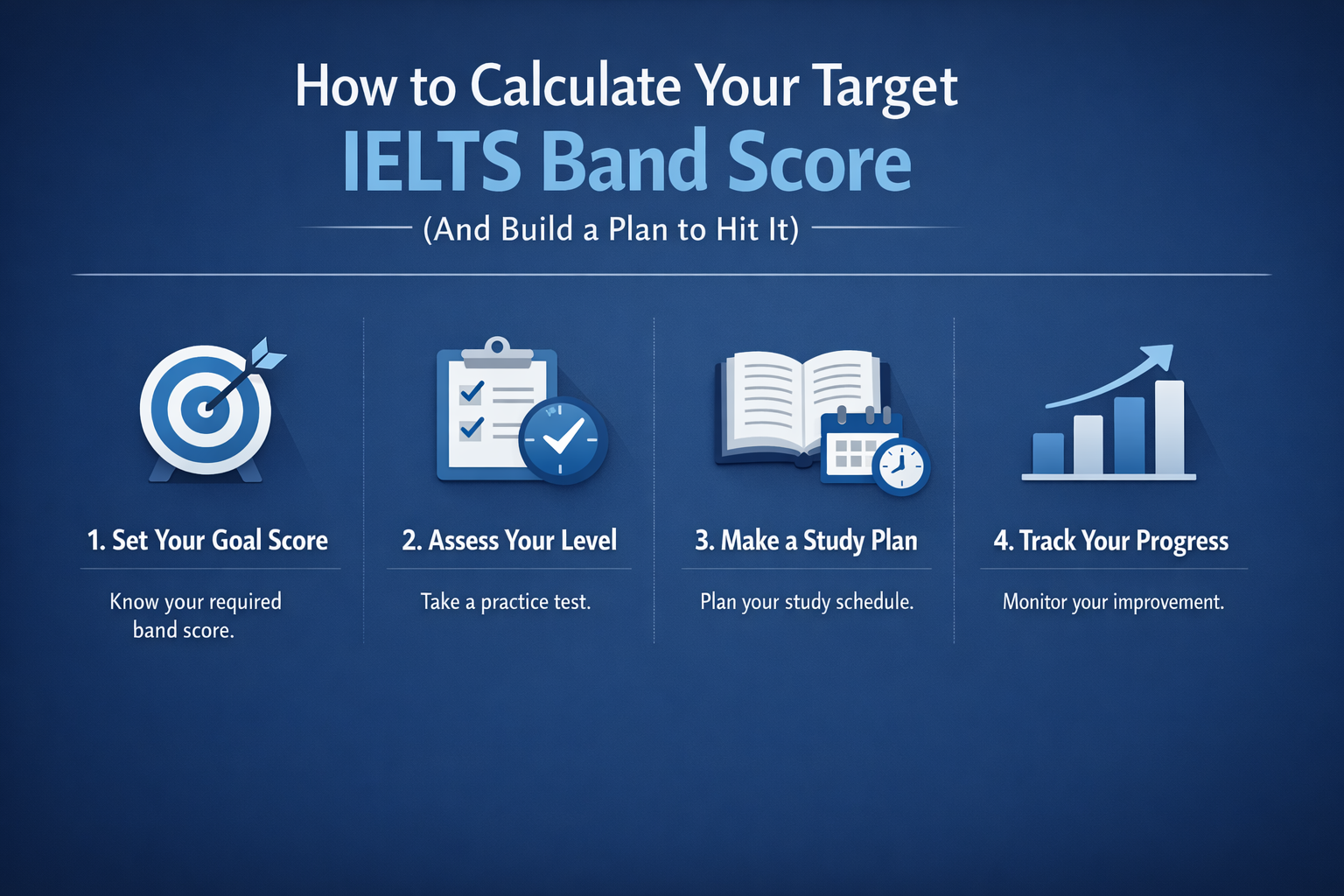
Step 1 — Know Your Exact Requirement
Different purposes require different scores — and the differences matter.
| Purpose | Typical Requirement | |---|---| | UK Student Visa | 6.0 overall, minimum 5.5 per skill | | Australia Student Visa | 6.0 overall, varies by institution | | Canada Express Entry | 6.0-7.0 depending on points needed | | UK Skilled Worker Visa | 4.0 per skill (lower than most expect) | | UK university undergraduate | 6.0-6.5 overall | | UK university postgraduate | 6.5-7.0 overall | | Medical/nursing registration UK | 7.0-7.5 overall, 7.0 per skill | | Top universities (Oxbridge, Russell Group) | 7.5-8.0 overall |
Important: Always check the specific requirement from the institution or authority you are applying to. These are general ranges — your specific requirement may differ.
Also check whether there are minimum per-skill requirements. Many applications require not just an overall band but a minimum score in each individual skill. Scoring 8.0 overall but 5.5 in Writing can mean a rejection even with a strong overall band.
Step 2 — Know Your Current Level
You cannot plan an improvement if you do not know your starting point.
Take a full practice test under real exam conditions — all four skills, full time limits, no breaks, no notes. Use official Cambridge IELTS materials for the most accurate calibration.
Record your score for each skill. Be honest. A practice score that flatters you leads to a preparation plan that does not work.
Step 3 — Calculate the Gap
The gap between your current score and your target score tells you exactly how much work is required.
A 0.5 band improvement in any skill is achievable in 4-6 weeks of targeted preparation.
A 1.0 band improvement requires 8-12 weeks of consistent, feedback-driven practice.
A 1.5 or greater improvement requires 3-6 months minimum — and often involves addressing fundamental language skills, not just exam technique.
Be realistic about your timeline. Attempting to improve by 2 bands in three weeks before an exam almost never succeeds — and the disappointment of failing again costs both money and motivation.
Step 4 — Identify Which Skills Give You the Most Return
Not all band improvements are equally achievable or equally valuable.
Reading and Listening are most responsive to technique improvement. Strong English speakers often score below their ability in these skills because of poor strategy — and strategy can be learned and applied quickly.
Writing takes longer to improve because it requires internalising new vocabulary, grammar structures, and essay organisation habits. But it is also the skill where targeted feedback makes the most dramatic difference.
Speaking is often the most anxiety-driven underperformance. Candidates with strong English score below their level because of nerves, not language ability. Regular practice under realistic conditions — recording yourself, timing yourself — reliably improves speaking scores.
Identify which skill has the biggest gap between your current level and your target. That skill gets the most preparation time.
Step 5 — Build Your Preparation Plan
A realistic preparation plan has three components:
Skill-specific practice: Targeted work on your weakest skill every day. Not general English improvement — specific IELTS task practice with evaluation and feedback.
Full test practice: One complete four-skill practice test per week under exam conditions. This builds stamina, time management, and realistic expectation of your current level.
Review and adjustment: After every practice test, identify what went wrong, why it went wrong, and what you will do differently next time. Practice without review is repetition without improvement.
The Preparation Timeline That Works
4 weeks before exam: Daily skill-specific practice. Full practice test every Sunday. Track scores weekly.
2 weeks before exam: Increase full practice tests to twice per week. Focus preparation time on your weakest skill only.
1 week before exam: Light practice only — one essay, one reading passage, some Speaking questions. No new material.
Day before: Rest, prepare physically, trust your preparation.
The Most Common Planning Mistake
Candidates spend 80% of their preparation time on the skills they enjoy or find easiest. If you love Writing and find Reading tedious, you will naturally gravitate toward Writing practice.
This feels productive. It is not — because it improves your strongest skill while leaving your weakest unchanged.
Your overall band score is the average of four skills. Improving your Band 8 Writing to Band 8.5 gains you 0.125 bands overall. Improving your Band 5.5 Reading to Band 6.5 gains you 0.25 bands overall — twice the impact for potentially less effort.
Always target the skill with the biggest gap first.
Using Your Target Band as Motivation
On difficult practice days — when your score is lower than expected, when an essay receives harsh feedback, when a listening test feels impossible — return to your reason.
Why do you need this score? What does it unlock? Visa approval. University admission. Career progression. A life in a different country.
The band score is not the goal. It is the key to the goal. Keep the goal visible and the preparation becomes easier to sustain.
🎯 Know exactly where you stand right now IELTS Evaluator gives you an instant band score on any IELTS essay with detailed feedback on every criterion. Use our free Band Score Calculator to calculate your overall band and plan your path to your target score.